

Today we bring you not one but two 1980 International Scout II Terra pickups, and amazingly, they’re both turbodiesels. Despite it’s success and the fact that new Scouts were on the drawing board at the time, this famous SUV came to an untimely end that year when International Harvester Corporation (IHC) sold it off in the wake of a one-two-three punch of a massive strike, OPEC II, and a recession. The last Scout was built on October 21, 1980.
Of course, the Scout is famous as an SUV, not a pickup, but it could always be had in either body style, and the late trucks like these were arguably the best of the lot. Both are from Washington State, but they’re at opposite ends of the visual spectrum: plain-jane and dressed up with “Rallye” graphics — one of the many tape-stripe packages available on 1970s Scouts.
They are doubly rare because of their Nissan-sourced turbodiesel engines. A potential antidote to the OPEC blues, the Turbodiesel replaced an earlier naturally-aspirated version of the same engine, and you could only get them in the final 11 months of Scout production.
Arguably the last five years of Scout II production were the most interesting of all, but the story of the Terra really goes back to the beginning.

The International Scout
IHC, founded in 1902 and known primarily for commercial trucks and farm equipment, had actually built cars in the early days. After 1910, it largely standardized on having a line of light-duty trucks which competed directly with the big Detroit players, but they were always a sideline business. The company began working on the Scout in the late 1950s in part to expand that sideline.
At that time it was envisioned as a light-duty pickup that could also double as an off-road vehicle with more creature comforts than the Jeep CJ, which had appeal to existing and potential new customers. This idea was not unlike the departed Willys Jeepster, and
International were certainly not alone in thinking that a more civilized off-road machine might find an audience — Rover had already been experimenting with “Road Rovers” as far back as 1951.Within the Scout package were two concepts that would be hugely popular in the next two decades: a pickup smaller than a conventional Detroit truck and a civilized off-roader. It was designed to be an open-topped vehicle that could be fitted with either a short canopy, making the back a pickup bed, or a long one, making it a two-door SUV. There was no separate bed, just different roofs and interiors and a removable lower bulkhead for the pickups.

Designed by Ted Ornas, the original International Scout debuted in late 1960. Initially, IHC thought most Scouts would be rear-drive pickups, but once on sale, 80% of the trucks were four-wheel drive hardtop “utilities.” A new market was born, and IHC quickly changed its marketing efforts to court off-road customers. Jeep soon responded, and Ford soon began working on the original Bronco. Chevy also mooted a light off-roader named “Blazer,” though the eventual K5 Blazer was nothing like this vehicle.
To keep up with the competition, IHC and Ornas began working on an enlarged second-generation model in 1965. The design of what became the Scout II was mostly finished by the end of 1967, but IHC’s resources for its non-commercial trucks were always a little stretched, and it put together a comprehensive redesign of its “Light Line” Pickups first, radically restyling them in 1969 with lines similar to the Scout II project, which then debuted in June of 1971 as the Scout II.

Scout II
When the Scout II did arrive, it was bigger and heavier than the original, in part because that was what buyers seemed to want to buy. The original Blazer was much larger than the early Scout or Bronco and quickly proved a big seller. The Scout II got off to a good start, with 30,000 sold the first year. Like its predecessor, the II would sell primarily as an SUV, but it retained the double-duty functionality of the original, offering pickup variations throughout the run.
In the early 1970s market changes kept putting IHC on the defensive with pickups large and small. In pickup configuration the 100-inch (254cm) wheelbase Scout II did not have a particularly large bed, nor was the bed separate as on a conventional pickup.
The removable-top Scout could be converted to a full SUV if you bought a second top, but this didn’t help it in the pure pickup market. A tidal wave of imported compact pickups from Japan, cheaper, smaller, and capable of hauling around just as much, effectively handicapped the heavier Scout.
Meanwhile IHC’s largest pickup trucks seemed to stumble in the face of newly-redesigned trucks from GM, Dodge and Ford while the Scout itself came under attack from Jeep’s reworked SJ-series 2-door, now called the Cherokee, Chevy’s K5 Blazer, and from late 1973, Chrysler’s Dodge Ramcharger and Plymouth Trailduster. The first OPEC crisis made all of these situations much worse.
IHC’s main businesses were heavy trucks, tractors and farm implements, and its pickups skewed heavily toward work trucks, not casual or lifestyle trucks, genres which were just beginning then. Because they never sold in the numbers of the Big Three’s trucks, they didn’t have great economies of scale, and the OPEC-induced downturn meant IHC decided to abandon full-size trucks (and the big Travelall) after the 1975 model year. But not abandon trucks entirely.

1976: Scout Terra, Traveler and Diesel
To address both the too-small problem of the Scout II pickup and the loss of the big pickups, IHC instead invested in new types of Scout.
For 1976, there were two new versions stretched 18” (46cm) between the B-pillar and the rear wheels, the hardtop Traveler, the Terra pickup. This proved a sweet spot in the market, as the Terra was quite a bit bigger than compact trucks like the Chevy LUV, but smaller than most full-size pickups, though short-bed big pickups were still common in the mid-1970s.
The Terra was still not properly a working truck, and still didn’t have a proper separate bed, but it could handle up to almost 2,000 pounds of stuff, putting it well into the half-ton category. The Scout Terra picked up its name from the earlier Scout haulers, while the Traveler was meant to reflect the earlier, larger four-door Travelall SUV.
IHC also reshuffled the engines. The Scout had always had a pretty varied array of engines, even a turbocharged four-cylinder for a brief period in the 1960s, and it still used IHC’s 196-cid (3.2-liter) OHV four as the base engine in 1975. There were also AMC-sourced straight sixes (232-cid/3.8L and 258-cid/4.2L) and International’s own 304 (5.0L) and 345 (5.6L) V8s. 1976 saw a very unlikely engine, Nissan’s 198-cid (3.2-liter) SD33 Diesel.
Usually found in the global-market Nissan Patrol, which anywhere else would have been a direct competitor to the Scout, the Patrol had been sold in America in the 1960s but dropped here in 1969. International, meanwhile, wanted a more efficient engine option than what it could build in-house, specifically for the purpose of exporting Scouts. Before settling on the Nissan engine, they also looked at Peugeot, Perkins, and Chrysler diesels. The Peugeot XDP-6.90 was the best of those, but wouldn’t fit properly.
The SD33 was a slow machine, particularly with an Automatic, but dead reliable and capable of 20 mpg. A turbocharged version of the SD33 debuted in Japan in 1978, and IHC planned to offer it as well for 1980.
1980 and the end of the Scout
The Terra, the Diesel, and the Traveler were not huge sellers, but they all provided a useful increase in volume for IHC and gave dealers and customers more choices. Many Terras and late 1970s Scouts had wild stripes and paint jobs, but IHC was still building plain-jane trucks all the while for people who wanted them.


The SD33T proved to be exactly right for the time, much more powerful than the SD33 and with similarly sparkling fuel economy and durability. The Scout had much to come, too. Proposals by Ornas for a 1980s-era Scout III were on the drawing board in the late 1970s, and these sophisticated off-roaders might have been on sale by 1983-84 had circumstances gone differently.
But they didn’t. Instead, things went south in a hurry in late 1979, just as OPEC II was cresting and a huge economic contraction, later made worse by the Reagan Administration, beginning.
In November, 1979, UAW workers struck against IHC over a long-simmering dispute about workplace transfer rights, an issue that had been brewing as far back as 1958. The strike lasted 172 days. The workers had a real case, though it was primarily IHC’s large truck business that they were targeting. Unfortunately, the niche-model Scout was the real casualty because it was still, despite its success, a sideline business for IHC.
Had there not been fallout from OPEC II and the subsequent double-dip recession, this might have worked, but all of Russell’s companies customized big, heavy vehicles like RVs, which were a hard sell in 1980. His empire dissolved that fall and took the Scout with it. The last II was built on Oct. 21, 1980.
In 1986, IHC became Navistar, and now Navistar is part of VW, hence the modern Scout revival. The connection is, well, tenuous, but it is real.


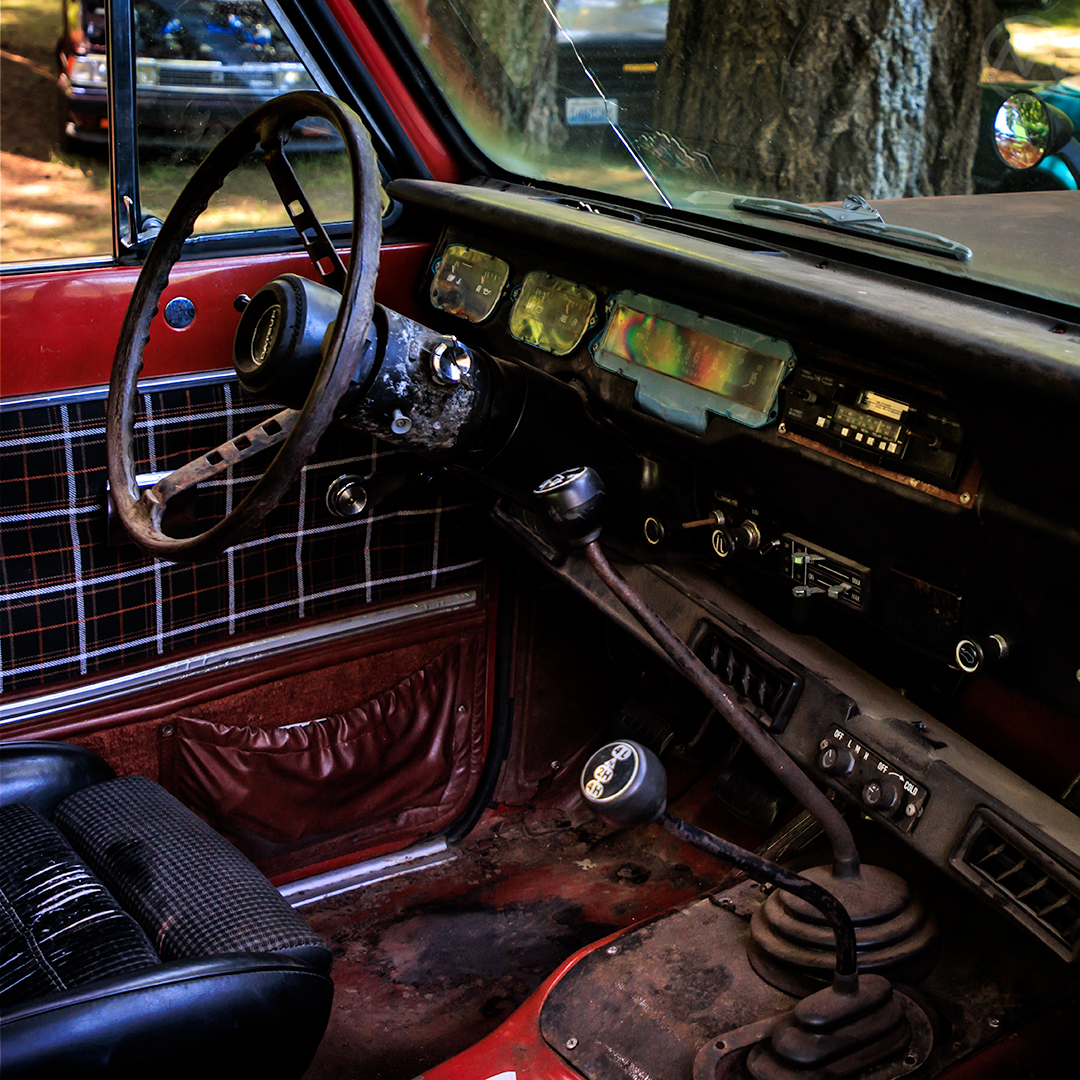
The mint-condition “Tahitian Red metallic” Scout Terra featured above is a low-grade diesel, and we spied it way back in 2017. The “Rallye” pickup is from 2025, and we spied that one at the Old School Reunion, despite the fact that it’s not a “foreign” vehicle. The Yellow Terra with the graphics is an non-diesel, and we spied it in a junkyard in 2019.
The Rallye is the most unusual one. Many Terras and late 1970s Scouts had wild stripes and paint jobs, and like all trucks of that era there were many graphics kits you could spec. They’re hard to restore now but these look original, and the combination of a turbodiesel truck and these sporty graphics in 1980 is definitely a rare combo. It also has what looks like the optional under-dash A/C unit and that giant winch up front. Clearly an uncommon build.